16个PHP魔术方法及其利用

本文最后更新于:10 个月前

16个php魔术方法及其利用

!!!!!!!转载自文章:https://zhuanlan.zhihu.com/p/109999421!!!!

1.__construct()

当创建对象时,PHP 类的构造方法是第一个被调用的方法。每个类都有构造方法。若你没在类中明确声明定义它,将会有一个默认的无参类构造方法存在,虽然它不会在类中定义出现。

  1. 构造方法的运用

类的构造方法通常用于执行一些初始化任务,诸如当创建对象时,为成员初始化赋值。

  1. 类中构造方法的声明格式
1
2
3
4
5
function __constrct([parameter list]){

方法具体实现 //通常为成员变量初始赋值。

}

注意: 在多数类中仅可以声明一个构造方法。因为, PHP 不支持构造方法重载。

下面是个完整的例子:

1
2
3
4
5
6
7
8
9
10
11
12
13
14
15
16
17
18
19
20
21
22
23
24
25
26
<?php
class Person
{
public $name;
public $age;
public $sex;

/**
* 明确定义含参的构造方法
*/
public function __construct($name="", $sex="Male", $age=22)
{
$this->name = $name;
$this->sex = $sex;
$this->age = $age;
}

/**
* say 方法定义
*/
public function say()
{
echo "Name:" . $this->name . ",Sex:" . $this->sex . ",Age:" . $this->age;
}

}

无参创建 $Person1 对象。

1
2
$Person1 = new Person();
echo $Person1->say(); //显示:Name:,Sex:Male,Age:22

使用一个参数 “Jams” 调用创建 $Person2 对象。

1
2
$Person2 = new Person("Jams");
echo $Person2->say(); // 显示: Name: Jams, Sex: Male, Age: 22

使用 3 个参数调用创建 $Person3 对象。

1
2
$Person3 = new Person ("Jack", "Male", 25);
echo $Person3->say(); // 显示:Name: Jack, Sex: Male, Age: 25

__destruct()

析构函数与构造函数相反。

析构函数允许你在销毁对象之前执行一些操作,例如关闭文件,清空结果集等等。

析构函数是 PHP 5 引入的新功能。

析构函数的声明与构造函数类似,以两个下划线开头,名称固定为 __destruct()。

析构函数的声明

1
2
3
4
function __destruct()
{
//method body
}

析构函数不能带参数

析构函数的使用

析构函数在类中一般不常见。它是类的可选部分,通常用于在类销毁之前完成一些清理任务。

这是使用析构函数的示例:

1
2
3
4
5
6
7
8
9
10
11
12
13
14
15
16
17
18
19
20
21
22
23
24
25
26
27
28
29
30
31
32
33
<?php
class Person{

public $name;
public $age;
public $sex;

public function __construct($name="", $sex="Male", $age=22)
{
$this->name = $name;
$this->sex = $sex;
$this->age = $age;
}

/**
* say method
*/
public function say()
{
echo "Name:".$this->name.",Sex:".$this->sex.",Age:".$this->age;
}

/**
* declare a destructor method
*/
public function __destruct()
{
echo "Well, my name is ".$this->name;
}
}

$Person = new Person("John");
unset($Person); //destroy the object of $Person created above

输出结果

1
Well, my name is John

__call()

该方法接受两个参数。第一个参数为未定义的方法名称,第二个参数则为传入方法的参数构成的数组

使用

1
2
3
4
function __call(string $function_name, array $arguments)
{
// method body
}

在程序中调用未定义方法时, __call() 方法将被调用。

示例

1
2
3
4
5
6
7
8
9
10
11
12
13
14
15
16
17
18
19
<?php
class Person
{
function say()
{
echo "Hello, world!<br>";
}

function __call($funName, $arguments)
{
echo "The function you called:" . $funName . "(parameter:" ; // Print the method's name that is not existed.
print_r($arguments); // Print the parameter list of the method that is not existed.
echo ")does not exist!!<br>\n";
}
}
$Person = new Person();
$Person->run("teacher"); // If the method which is not existed is called within the object, then the __call() method will be called automatically.
$Person->eat("John", "apple");
$Person->say();

显示结果

1
2
3
The function you called: run (parameter: Array([0] => teacher)) does not exist!
The function you called: eat (parameter: Array([0] => John[1] => apple)) does not exist!
Hello world!

4. __callStatic()

当在程序中调用未定义的静态方法__callStatic() 方法将会被自动调用。

__callStatic() 的用法类似于 __call() 。下面举个例子:

1
2
3
4
5
6
7
8
9
10
11
12
13
14
15
16
17
18
19
<?php
class Person
{
function say()
{
echo "Hello, world!<br>";
}

public static function __callStatic($funName, $arguments)
{
echo "The static method you called:" . $funName . "(parameter:" ; // 打印出未定义的方法名。
print_r($arguments); // 打印出未定义方法的参数列表。
echo ")does not exist!<br>\n";
}
}
$Person = new Person();
$Person::run("teacher"); // 如果此项目内不存在的方法被调用了,那么 __callStatic() 方法将被自动调用。
$Person::eat("John", "apple");
$Person->say();

执行结果如下:

1
2
3
The static method you called: run (parameter: Array([0] => teacher)) does not exist!
The static method you called: eat (parameter: Array([0] => John[1] => apple)) does not exist!
Hello world!

5.__get()

当你尝试在外部访问对象的私有属性时,应用程序将抛出异常并结束运行。我们可以使用 __get 方法解决该问题。该方法可以获取从对象外部获取私有属性的值。举例如下

1
2
3
4
5
6
7
8
9
10
11
12
13
14
15
16
17
18
19
20
21
22
23
24
25
26
27
28
<?php
class Person
{
private $name;
private $age;

function __construct($name="", $age=1)
{
$this->name = $name;
$this->age = $age;
}

public function __get($propertyName)
{
if ($propertyName == "age") {
if ($this->age > 30) {
return $this->age - 10;
} else {
return $this->$propertyName;
}
} else {
return $this->$propertyName;
}
}
}
$Person = new Person("John", 60); // Instantiate the object with the Person class and assign initial values to the properties with the constructor.
echo "Name:" . $Person->name . "<br>"; // When the private property is accessed, the __get() method will be called automatically,so we can get the property value indirectly.
echo "Age:" . $Person->age . "<br>"; // The __get() method is called automatically,and it returns different values according to the object itself.

结果显示如下

1
2
Name: John
Age: 50

6. __set()

set ($property,$value) 方法用于设置类的私有属性。分配了未定义的属性后,将触发 set () 方法,并且传递的参数是设置的属性名称和值。

面是演示代码:

1
2
3
4
5
6
7
8
9
10
11
12
13
14
15
16
17
18
19
20
21
22
23
24
25
26
27
28
29
30
31
32
<?php
class Person
{
private $name;
private $age;

public function __construct($name="", $age=25)
{
$this->name = $name;
$this->age = $age;
}

public function __set($property, $value) {
if ($property=="age")
{
if ($value > 150 || $value < 0) {
return;
}
}
$this->$property = $value;
}

public function say(){
echo "My name is ".$this->name.",I'm ".$this->age." years old";
}
}

$Person=new Person("John", 25); //请注意,类初始化并为“name”和“age”分配初始值。
$Person->name = "Lili"; // "name" 属性值被成功修改。如果没有__set()方法,程序将报错。
$Person->age = 16; // "age"属性修改成功。
$Person->age = 160; //160是无效值,因此修改失败。
$Person->say(); //输出:My name is Lili, I'm 16 years old。

代码运行结果:

1
My name is Lili, I'm 16 years old

7. __isset()

在使用__isset () 方法之前,让我先解释一下 isset () 方法的用法。isset () 方法主要用于确定是否设置了此变量。

如果在对象外部使用 isset () 方法,则有两种情况:

如果该参数是公共属性,则可以使用 isset () 方法确定是否设置了该属性。

如果参数是私有属性,则 isset () 方法将不起作用。

那么对于私有属性,有什么办法知道它是否被设置了吗?当然,只要在类中定义__isset () 方法,就可以在类外部使用 isset () 方法来确定是否设置了私有属性。

当在未定义或不可访问的属性上调用 isset () 或 empty () 时,将调用__isset () 方法。下面是一个例子:

1
2
3
4
5
6
7
8
9
10
11
12
13
14
15
16
17
18
19
20
21
22
23
24
25
26
27
28
29
<?php
class Person
{
public $sex;
private $name;
private $age;

public function __construct($name="", $age=25, $sex='Male')
{
$this->name = $name;
$this->age = $age;
$this->sex = $sex;
}

/**
* @param $content
*
* @return bool
*/
public function __isset($content) {
echo "The {$content} property is private,the __isset() method is called automatically.<br>";
echo isset($this->$content);
}
}

$person = new Person("John", 25); // Initially assigned.
echo isset($person->sex),"<br>";
echo isset($person->name),"<br>";
echo isset($person->age),"<br>";

代码运行结果如下:

1
2
3
4
5
1
The name property is private,the __isset() method is called automatically.
1
The age property is private,the __isset() method is called automatically.
1

8. __unset()

isset () 方法类似,当在未定义或不可访问的属性上调用 unset () 方法时,将调用 unset () 方法。下面是一个例子:

1
2
3
4
5
6
7
8
9
10
11
12
13
14
15
16
17
18
19
20
21
22
23
24
25
26
27
28
29
<?php
class Person
{
public $sex;
private $name;
private $age;

public function __construct($name="", $age=25, $sex='Male')
{
$this->name = $name;
$this->age = $age;
$this->sex = $sex;
}

/**
* @param $content
*
* @return bool
*/
public function __unset($content) {
echo "It is called automatically when we use the unset() method outside the class.<br>";
echo isset($this->$content);
}
}

$person = new Person("John", 25); // Initially assigned.
unset($person->sex),"<br>";
unset($person->name),"<br>";
unset($person->age),"<br>";

代码的运行结果如下:

1
2
3
4
It is called automatically when we use the unset() method outside the class.
1
It is called automatically when we use the unset() method outside the class.
1

9. __sleep()

serialize () 方法将检查类中是否有魔术方法__sleep ()。如果存在,将首先调用该方法,然后执行序列化操作。

__sleep () 方法通常用于指定保存数据之前需要序列化的属性。如果有一些非常大的对象不需要全部保存,那么您会发现此功能非常有用。

有关详细信息,请参考以下代码:

1
2
3
4
5
6
7
8
9
10
11
12
13
14
15
16
17
18
19
20
21
22
23
24
25
26
27
<?php
class Person
{
public $sex;
public $name;
public $age;

public function __construct($name="", $age=25, $sex='Male')
{
$this->name = $name;
$this->age = $age;
$this->sex = $sex;
}

/**
* @return array
*/
public function __sleep() {
echo "It is called when the serialize() method is called outside the class.<br>";
$this->name = base64_encode($this->name);
return array('name', 'age'); // It must return a value of which the elements are the name of the properties returned.
}
}

$person = new Person('John'); // Initially assigned.
echo serialize($person);
echo '<br/>';

代码运行结果如下:

1
2
It is called when the serialize() method is called outside the class.
O:6:"Person":2:{s:4:"name";s:8:"5bCP5piO";s:3:"age";i:25;}

10. __wakeup()

与 sleep () 方法相比,wakeup () 方法通常用于反序列化操作,例如重建数据库连接或执行其他初始化操作。

下面是相关实例:

1
2
3
4
5
6
7
8
9
10
11
12
13
14
15
16
17
18
19
20
21
22
23
24
25
26
27
28
29
30
31
32
33
34
35
36
37
<?php
class Person
{
public $sex;
public $name;
public $age;

public function __construct($name="", $age=25, $sex='Male')
{
$this->name = $name;
$this->age = $age;
$this->sex = $sex;
}

/**
* @return array
*/
public function __sleep() {
echo "It is called when the serialize() method is called outside the class.<br>";
$this->name = base64_encode($this->name);
return array('name', 'age'); // It must return a value of which the elements are the name of the properties returned.
}

/**
* __wakeup
*/
public function __wakeup() {
echo "It is called when the unserialize() method is called outside the class.<br>";
$this->name = 2;
$this->sex = 'Male';
// There is no need to return an array here.
}
}

$person = new Person('John'); // Initially assigned.
var_dump(serialize($person));
var_dump(unserialize(serialize($person)));

代码运行结果如下:

1
2
3
4
It is called when the serialize() method is called outside the class.
string(58) "O:6:"Person":2:{s:4:"name";s:8:"5bCP5piO";s:3:"age";i:25;}"
It is called when the unserialize() method is called outside the class.
object(Person)#2 (3) { ["sex"]=> string(3) "Male" ["name"]=> int(2) ["age"]=> int(25) }
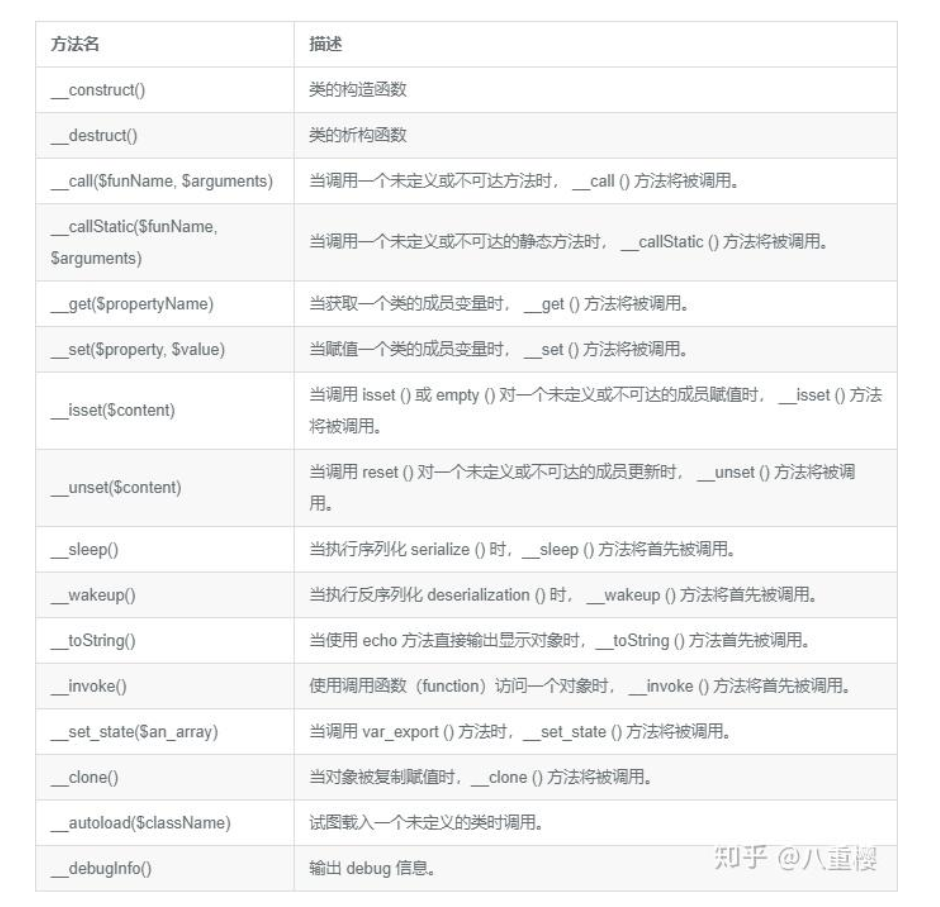
11. __toString()

使用 echo 方法直接打印对象时,将调用__toString () 方法。

注意:此方法必须返回一个字符串,否则将在 E_RECOVERABLE_ERROR 级别上引发致命错误。而且您也不能在__toString () 方法中抛出异常。

下面是相关的实例:

1
2
3
4
5
6
7
8
9
10
11
12
13
14
15
16
17
18
19
20
21
22
<?php
class Person
{
public $sex;
public $name;
public $age;

public function __construct($name="", $age=25, $sex='Male')
{
$this->name = $name;
$this->age = $age;
$this->sex = $sex;
}

public function __toString()
{
return 'go go go';
}
}

$person = new Person('John'); // Initially assigned.
echo $person;

运行代码结果如下:

1
go go go

那么,如果在类中未定义__toString () 方法怎么办?让我们尝试一下。

1
2
3
4
5
6
7
8
9
10
11
12
13
14
15
16
17
18
<?php
class Person
{
public $sex;
public $name;
public $age;

public function __construct($name="", $age=25, $sex='Male')
{
$this->name = $name;
$this->age = $age;
$this->sex = $sex;
}

}

$person = new Person('John'); // Initially assigned.
echo $person;

运行代码结果如下:

1
Catchable fatal error: Object of class Person could not be converted to string in D:\phpStudy\WWW\test\index.php on line 18

显然,它在页面上报告了一个致命错误,PHP 语法不支持这样的写法。

12. __invoke()

当您尝试以调用函数的方式调用对象时,__ invoke () 方法将被自动调用。

注意:此功能仅在 PHP 5.3.0 及更高版本中有效。

下面是相关实例:

1
2
3
4
5
6
7
8
9
10
11
12
13
14
15
16
17
18
19
20
21
22
<?php
class Person
{
public $sex;
public $name;
public $age;

public function __construct($name="", $age=25, $sex='Male')
{
$this->name = $name;
$this->age = $age;
$this->sex = $sex;
}

public function __invoke() {
echo 'This is an object';
}

}

$person = new Person('John'); // Initially assigned.
$person();

运行代码结果如下:

1
This is an object

如果坚持使用对象作为方法 (但未定义__invoke () 方法),则将得到以下结果:

1
Fatal error: Function name must be a string in D:\phpStudy\WWW\test\index.php on line 18

13.__set_state()

从 PHP 5.1.0 开始,在调用 var_export () 导出类代码时会自动调用__set_state () 方法。

__set_state () 方法的参数是一个包含所有属性值的数组,其格式为 array (‘property’=> value,…)

在以下示例中,我们没有定义__set_state () 方法:

1
2
3
4
5
6
7
8
9
10
11
12
13
14
15
16
17
18
<?php
class Person
{
public $sex;
public $name;
public $age;

public function __construct($name="", $age=25, $sex='Male')
{
$this->name = $name;
$this->age = $age;
$this->sex = $sex;
}

}

$person = new Person('John'); // Initially assigned.
var_export($person);

执行代码结果如下:

1
Person::__set_state(array( 'sex' => 'Male', 'name' => 'John', 'age' => 25, ))

显然,对象的属性已打印。

现在让我们看看定义__set_state () 方法的另一种情况:

1
2
3
4
5
6
7
8
9
10
11
12
13
14
15
16
17
18
19
20
21
22
23
24
25
26
<?php
class Person
{
public $sex;
public $name;
public $age;

public function __construct($name="", $age=25, $sex='Male')
{
$this->name = $name;
$this->age = $age;
$this->sex = $sex;
}

public static function __set_state($an_array)
{
$a = new Person();
$a->name = $an_array['name'];
return $a;
}

}

$person = new Person('John'); // Initially assigned.
$person->name = 'Jams';
var_export($person);

执行代码结果如下:

1
Person::__set_state(array( 'sex' => 'Male', 'name' => 'Jams', 'age' => 25, ))

14. __clone()

在 PHP 中,我们可以使用 clone 关键字通过以下语法克隆对象:

1
$copy_of_object = clone $object;

但是,使用 clone 关键字只是一个浅拷贝,因为所有引用的属性仍将指向原始变量。

如果在对象中定义了 clone () 方法,则将在复制生成的对象中调用 clone () 方法,该方法可用于修改属性的值 (如有必要)。

下面是相关的示例:

1
2
3
4
5
6
7
8
9
10
11
12
13
14
15
16
17
18
19
20
21
22
23
24
25
26
27
28
29
<?php
class Person
{
public $sex;
public $name;
public $age;

public function __construct($name="", $age=25, $sex='Male')
{
$this->name = $name;
$this->age = $age;
$this->sex = $sex;
}

public function __clone()
{
echo __METHOD__."your are cloning the object.<br>";
}

}

$person = new Person('John'); // Initially assigned.
$person2 = clone $person;

var_dump('persion1:');
var_dump($person);
echo '<br>';
var_dump('persion2:');
var_dump($person2);

运行代码结果如下:

1
2
3
Person::__clone your are cloning the object.
string(9) "persion1:" object(Person)#1 (3) { ["sex"]=> string(3) "Male" ["name"]=> string(6) "John" ["age"]=> int(25) }
string(9) "persion2:" object(Person)#2 (3) { ["sex"]=> string(3) "Male" ["name"]=> string(6) "John" ["age"]=> int(25) }

15.__autoload()

__autoload () 方法可以尝试加载未定义的类。

过去,如果要在程序文件中创建 100 个对象,则必须使用 include () 或 require () 来包含 100 个类文件,或者必须在同一类文件中定义 100 个类。 例如以下:

1
2
3
4
5
6
7
8
9
10
11
12
13
14
15
16
17
18
19
20
21
/**
* file non_autoload.php
*/

require_once('project/class/A.php');
require_once('project/class/B.php');
require_once('project/class/C.php');
.
.
.

if (ConditionA) {
$a = new A();
$b = new B();
$c = new C();
// …
} else if (ConditionB) {
$a = newA();
$b = new B();
// …
}

那么,如果我们使用__autoload () 方法呢?

1
2
3
4
5
6
7
8
9
10
11
12
13
14
15
16
17
18
19
20
/**
* file autoload_demo.php
*/
function __autoload($className) {
$filePath = “project/class/{$className}.php”;
if (is_readable($filePath)) {
require($filePath);
}
}

if (ConditionA) {
$a = new A();
$b = new B();
$c = new C();
// …
} else if (ConditionB) {
$a = newA();
$b = new B();
// …
}

当 PHP 引擎第一次使用类 A 时,如果未找到类 A,则 autoload 方法将被自动调用,并且类名称 “A” 将作为参数传递。因此,我们在 autoload () 方法中需要做的是根据类名找到相应的类文件,然后将其包含在内。如果找不到该文件,则 php 引擎将抛出异常。

16. __debugInfo()

当执行 var_dump() 方法时,__debugInfo() 方法会被自动调用。如果 __debugInfo() 方法未被定义,那么 var_dump 方法或打印出这个对象的所有属性。

举例说明:

1
2
3
4
5
6
7
8
9
10
11
12
13
14
15
16
17
18
19
<?php
class C {
private $prop;

public function __construct($val) {
$this->prop = $val;
}

/**
* @return array
*/
public function __debugInfo() {
return [
'propSquared' => $this->prop ** 2,
];
}
}

var_dump(new C(42));

执行结果:

1
object(C)#1 (1) { ["propSquared"]=> int(1764) }

注意:__debugInfo () 方法应该在 PHP 5.6.0 及以上版本中使用。